Temperature Assurance Beyond the Pharmacy Fridge
When medicines leave controlled storage, pharmacy teams need confidence that temperature conditions have been maintained — and clear evidence when they haven't.
Temperature control is an established part of pharmacy practice. Refrigerated medicines and vaccines are commonly stored at 2–8°C, while many other medicines require controlled room-temperature conditions, commonly 15–25°C.
Within the pharmacy, established storage procedures and monitoring systems help maintain these conditions.
But medicines don't always stay there.
Vaccines may travel to vaccination clinics, care homes or other locations. Medicines may move between sites, travel through distribution networks or spend periods away from their usual controlled storage.
This raises an important question:
How do you know what temperature conditions those medicines have experienced while they have been away?
From temperature monitoring to temperature assurance
Recording temperature is only part of the solution.
For the person responsible for the medicines, the information also needs to be easy to understand, available when a decision needs to be made and supported by evidence when required.
Consider vaccines travelling from a pharmacy to a vaccination clinic.
A temperature monitor can travel alongside the vaccines, providing evidence of the conditions experienced while they are away from the pharmacy fridge.
At the clinic — or if unused vaccines are returned — staff can quickly establish whether predefined time and temperature limits have been reached.
That information can support decisions about administration, returning medicines to stock or whether further assessment is required, in accordance with the medicine manufacturer's requirements and the organisation's own procedures.
Sometimes you need an answer before you need the data
Detailed temperature data has an important role, but downloading and analysing a report shouldn't necessarily be the first step every time someone needs to check a consignment.
Often the first question is much simpler:
Has a defined time and temperature limit been reached?
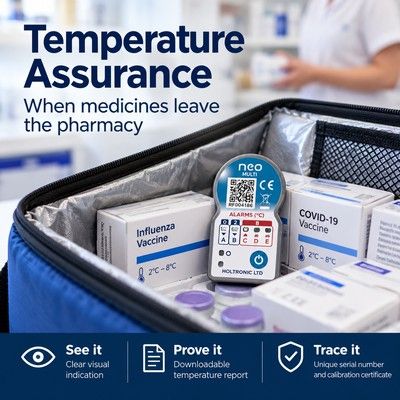
For refrigerated medicines and vaccines, Holtronic's neo® RF provides a clear visual indication of predefined excursions around the 2–8°C range.
The visual display can indicate when temperatures have:
- risen above 8°C for 5 minutes
- risen above 8°C for 30 minutes
- risen above 8°C for 60 minutes
- fallen below 2°C for 30 minutes
- fallen below 0°C for 10 minutes
This means the person handling the medicines can quickly identify whether a defined limit has been reached without first connecting the device and analysing the data.
When further evidence is required, a downloadable temperature report provides a record that can be retained for filing and traceability.
It provides two levels of information: an immediate visual indication for a quick assessment, backed by a detailed report when evidence is required.
Temperature assurance doesn't stop at 8°C
Refrigerated medicines are an obvious focus, but temperature control extends beyond the 2–8°C cold chain.
Many medicines require controlled room-temperature conditions, commonly 15–25°C.
Holtronic's neo® RG applies the same straightforward approach to this range, providing visual indications when predefined time and temperature limits below 15°C or above 25°C have been reached, together with an additional high-temperature indication above 30°C.
This allows pharmacy teams, healthcare organisations and medicine distributors to apply a similar monitoring approach across both refrigerated and controlled room-temperature products.
Reusable or single-use? The application should decide
There isn't one temperature-monitoring format that is right for every medicine movement.
Where medicines regularly travel between a pharmacy and a clinic and the monitor returns with them, a reusable device can provide a highly cost-effective approach.
Holtronic's neo® RF and neo® RG can be reset for a new monitoring cycle — for example, for the next day's clinic or the next movement of medicines.
The reset is tamper-controlled, helping organisations maintain control over when a completed monitoring cycle is cleared and a new one begins.
In other applications, the monitor may travel with a medicine or consignment and never return to the sender. In these situations, a single-use device may be the more practical choice.
Holtronic therefore offers both approaches:
2–8°C refrigerated medicines and vaccines
neo® RF — reusable | neo® DF — single-use
15–25°C controlled room-temperature medicines
neo® RG — reusable | neo® DG — single-use
Rather than forcing a process to fit a particular type of logger, the monitoring solution can be selected around the way the medicines actually move.
Assurance also requires traceability
The information provided by a temperature monitor is only useful if there is confidence in the device behind it.
Every neo® device is 100% tested, individually identified with a unique serial number and has its own calibration certificate.
This device-level identification, combined with downloadable reporting where required, provides an additional layer of traceability — connecting the individual monitoring device with its supporting calibration documentation and temperature record.
For pharmacy and healthcare organisations working within established quality procedures, that evidence can be just as important as the immediate visual result.
Making temperature information useful
Good temperature monitoring shouldn't simply generate more data.
It should help the person responsible for medicines answer the questions that actually matter:
Have the required temperature conditions been maintained?
Can I quickly see if a defined limit has been reached?
Can I produce evidence when it is required?
Can I trace that information back to an individually identified and calibrated device?
And importantly:
Does the monitoring solution fit the way we actually handle and move our medicines?
Bringing these elements together can make temperature monitoring simpler for the people using it while strengthening the evidence available to pharmacy, healthcare and distribution organisations.
Ultimately, the goal isn't simply to monitor temperature.
It is to provide temperature assurance — at a glance, with the evidence to back it up.
Holtronic will be exhibiting at The Pharmacy Show, NEC Birmingham, 11–12 October 2026, Stand M46. Visit us to see the neo® range and discuss practical temperature monitoring for medicines and vaccines.