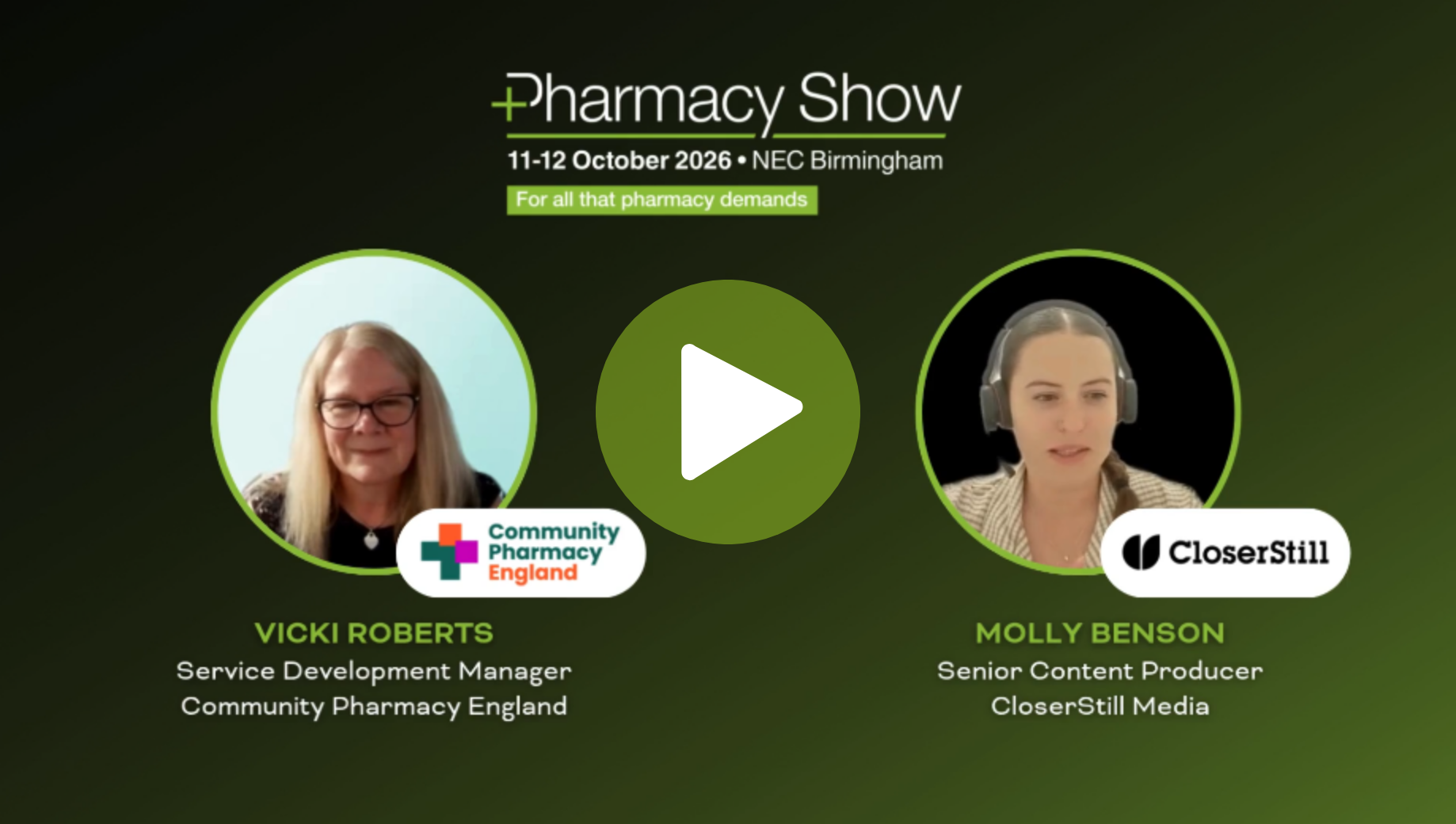
Meet the Speaker – Vicki Roberts, Service Development Manager, Community Pharmacy England
)
Molly: Hi, Vicki, thank you so much for joining me today. For anyone that doesn't know, Vicki will be joining us at the Pharmacy Show this October for two sessions in our Public Health and Prevention Theatre. Today, we're going to talk a little bit more about Vicki's role and experience and some of the developments she's seeing across community pharmacy and look ahead to some of the topics she'll be discussing at the show as well.
I thought we could start by talking a little bit about your background. You've worked across community pharmacy, NHS England, Local Pharmaceutical Committees (LPCs) and Community Pharmacy England (CPE). How have those different perspectives shaped the way you think about pharmacy services and what makes them work well in practice?
Vicki: Great, thanks Molly and it's great to be with you today sharing some thoughts ahead of the pharmacy show. So, I've been qualified for over thirty years now and my career has predominantly been community pharmacy with a little bit of medicines management experience in there. But you're right, in that time, I've undertaken roles across various organisations, including provider roles within Lloyds Pharmacy. And then my roles at NHS England gave me some really valuable commissioning experience, then most recently, as a chief officer of an LPC before moving to Community Pharmacy England.
I guess my experience in all of those organisations has given me a really broad view of the sector, which really helps me in the current role that I do at Community Pharmacy England. But I think first and foremost for me in any role that I've done, it's about putting the patients and population at the centre of my thinking. And then very closely followed by the pharmacy teams that are delivering services on behalf of providers. And I think, you know, if you put patients and pharmacy teams at the centre of everything that you do, whichever role that you're in, you can't really go far wrong. That's something that I've carried with me through all of the roles that I've undertaken.
And for those that might not be familiar with your role, what does service development at Community Pharmacy England involve and what are some of the main priorities at the moment?
Within the pharmacy services team at Community Pharmacy England, the work is sort of split into two sections really. Colleagues of mine work on national services, which are predominantly the advanced services. I've been very busy recently on the Meningitis B service and other vaccination services, in addition to things like the Pharmacy Quality Scheme and looking at the prescribing service that will come out later this year. And then my role is very much focused on ‘local’, whether that's locally commissioned services, which we'll talk about in a little bit more detail in just a while, or local development.
I spend a lot of time working with LPCs around neighbourhood working, and system working, and what that means in reality. So, my focus on neighbourhood health is one of the key ones at the moment. Neighbourhood health is one of those areas where it's different all over the country, and that's quite hard for community pharmacy because we haven't got all of the answers written down. We're finding a way through it with partners as we go. Other things that I’m focusing on at the moment are the Cardiovascular Disease Modern Service Framework and what that means in terms of opportunity for community pharmacy. I do quite a lot of work around various policy areas that impact on local services, local commissioning, local relationships, and translating the policy and the guidance that comes out from NHS England and Department of Health into things that make sense for our LPCs and our pharmacy teams.
One of your sessions at Pharmacy Show will explore how neighbourhood health can help to reduce some of the health inequalities we're seeing at the moment. As care is delivered closer to home, where do you see the biggest opportunities for community pharmacy to contribute to neighbourhood health and help tackle those?
I think if we take a step back and think about the NHS 10-Year Health Plan, I don't think anybody would disagree with the three shifts and aspirations of that. And in fact, they've been around for much longer than the 10-Year Plan, just dressed up in a slightly different way this time. But I don't think you can think about delivering care closer to home without putting community pharmacy at the centre of that. Pharmacies are located in every community, in every neighbourhood, and we've been delivering neighbourhood health for decades;, as far back as I can remember when I first qualified as a pharmacist.
I don't think we can underestimate and undervalue what we do at the moment in community pharmacy. Yes, there will be opportunities in the future, but what we do now is really important for the patients that we serve. We are the most accessible location for health care advice and health care services, and many pharmacies still provide open access without needing an appointment for specialist care.
Community pharmacy has definitely moved a long way, in that we're not just a dispenser of medicines anymore; there's so much more we do in terms of those clinical services. But in terms of the biggest opportunities, I would say that in the now, those opportunities should be focused on optimising national service delivery; the services like Pharmacy First, pharmacy contraception service, hypertension case finding, and then some of the older advanced services like New Medicine Services (NMS), Discharge Medicine Service (DMS), and the more historical vaccination services as well. Those services provide a key focus and key benefits for neighbourhood health and true community assets for the populations within those areas. If I was giving advice to somebody on where to start with neighbourhood health, it would be around national services and optimising delivery before going on to think about local services. I'm not saying that local services aren't important, but with Integrated Care Board (ICB) restructures, and developing new system structures, and neighbourhood health still being quite immature in lots of areas, I think we should use that opportunity to consolidate and optimise those national services, build the relationships, build the trust in that area, and then go on to think about what else community pharmacy can do?
There can sometimes be a gap between a good idea for a pharmacy service, but then making it work successfully on the ground in a community pharmacy. In your experience, what are the key ingredients that make a locally commissioned service work really well?
It's a really good question, Molly. I think there's various stages of this that we need to consider. First and foremost, a good idea needs a really strong business case behind it that's articulated clearly in terms of the benefit and value for commissioners. That value needs to be compelling in terms of patient outcomes, but also financial outcomes and financial return for the commissioner, which is a massive hurdle in its own right. But once you have got a commissioner that’s bought into a new service development, then the key is getting the service specification developed in such a way that it's robust; it's supported by a really good comms plan. Also, if there's any digital development or digital integration that's required, that's considered too. Then, wider pathway integration, because I think gone are the days now where local services are developed in isolation. They must form part of that bigger pathway that strategic commissioners will be thinking about.
Then obviously funding. We're in quite an interesting place, I think, from a community pharmacy perspective, in that we have got capacity and resource constraints. If somebody is looking to commission or develop a new service, it's got to be attractive for pharmacy providers to deliver. If there is only one consultation room or there is only one pharmacist and one pharmacy technician, sometimes contractors have to make really difficult decisions about which services they're going to provide. It must be supported by robust remuneration that makes it sustainable and attractive for people to deliver.
Relationships have ever been as important as they are now. We had a period where we had fairly stable ICBs but with the recent restructure, we know that lots of our community pharmacy friends in those roles have moved on.
You could say that it creates a potential opportunity to build new relationships, but there's also a lot of education that's needed and awareness to ensure that people taking on responsibility for community pharmacy have the right knowledge and understand what we do, and definitely what we don't do, as well. Those relationships are critical, and LPCs play a massive role in building those strategic relationships with commissioners and wider stakeholders and the voluntary sector, and on behalf of contractors and pharmacy teams. We all know how busy ‘business as usual’ day-to-day life is in a pharmacy; it's quite difficult at times for our pharmacy teams to stop and think: ‘what's going on beyond the four walls of my pharmacy?’ which is key for the LPCs. That's a role that the LPCs undertake really well.
If I was if I was working as a frontline community pharmacist again, I would be saying, ‘Who can you build relationships with? Who have you got relationships with already? Can you seek to take those to the next level?’
Having regular contact with a GP about out of stock medication, for example, isn't a relationship; it's been able to turn up at the surgery and have a cup of tea with the Practice Manager and talk about issues that are affecting both of you, thinking about what can you do in your local area to elevate the prominence of community pharmacy and the role that it can play in neighbourhood care.
I want to break down what specific role community pharmacies play in reaching people who might struggle otherwise to access health care. What needs to be in place to make sure that pharmacies can do this properly?
It's really difficult for pharmacy teams to think about what's going on beyond the four walls of their pharmacy. We know that some pharmacies undertake outreach work where there is a population health need identified through various data sources and feedback. There's an important role there, but again, it needs to be properly funded to enable the pharmacy teams to undertake that work. We need to leverage the support and allyship we get from organisations like Healthwatch, patient participation groups, and other groups that represent community pharmacy. They can help to share the message about the value of community pharmacy as an asset on our behalf.
Our pharmacy teams are our biggest asset. They tend to live in the communities that that they work in, and so a conversation at the school gates when picking up the kids around some of the conditions of Pharmacy First can be as valuable as somebody walking into the pharmacy themselves.
LPCs and pharmacy contractors themselves tend to get involved in lots of awareness events as well to spread the message. Some LPCs go to university fairs to talk about what community pharmacy does. Looking for opportunities like that to spread the word is important; educating patients who wouldn't ordinarily hear the message.
At Pharmacy Show later this year, you'll also be speaking in a session exploring new delivery models for Opiate Substitution Therapy (OST). From a service development perspective, what are some of the challenges around delivering OST through community pharmacy, and where do you see opportunities for the service to evolve?
I'm really looking forward to this session. The pandemic led to quite a lot of OST substance supervised patients not getting supervision services anymore, which is not good from a service user perspective. But it also wasn't great from a community pharmacy perspective as well, because lots of those pharmacies that saw a reduction in their supervised clients, would have also seen a massive reduction in the income from that service as well. They would then have had to look for new services to fill that funding gap for them. This meant that after the pandemic, as the numbers of OST patients started to rise again, some pharmacies will have been hesitant about reintegrating that service because they'd found other services with equal, potentially even greater income to fill that gap for them.
Another challenge is that there are always one or two service users who don't always treat the pharmacy team with the respect that they deserve. We've seen a lot in the press recently about abuse in pharmacies. Also the theft of high value lines, which, in times when community pharmacy is struggling to keep itself afloat financially, just cannot afford those losses.
They are the main challenges that pharmacy owners and pharmacy teams face with this service, but I'm really excited to be talking about innovation and new models. I'll be doing that alongside Mohammed Fessal, Director of Pharmacy at Change Grow Live (CGL). CGL have developed a new service over the last few years called Core MAT Service on the back of the fact that they were seeing a decline in the pharmacy availability of services for OST service users. The Core MAT Service is great in that it recognises that community pharmacy provides so much more than a ‘per swallow’ transaction for these patients. It acknowledges and remunerates all patients who receive an OST prescription, irrespective of whether it's supervised or not. Then there's additional elements to the service; there's an annual wellbeing check for the service user as well; recognising that holistic care that community pharmacy provides.
Let’s face it; our community pharmacists will see these clients more regularly than any other healthcare professional, so they'll notice when things aren't quite right. By the recognition of it not just being a transactional relationship between the service user and the community pharmacy, I think we've actually taken massive strides forward. I'd be really keen to see more of that type of service being commissioned across the country.
We're entering a world where we will have more prescribing pharmacists in community pharmacy so there could potentially be an opportunity to look at prescribing pharmacists supporting drug service clinics, and to see some innovation and pilot services as well. This is an area where we will start to see some exciting developments over time, and it'll be great to be part of that and support our pharmacy owners and pharmacy teams with those developments.
I'm glad to hear you're excited for both sessions - we're very excited to have you. What are you most looking forward to about being at Pharmacy Show this year?
I think I've probably been to Pharmacy Show every year for probably at least the last twenty years. If there was a gold badge for attendance, I'm sure I'd have one!
For me, the opportunity to have real life conversations with anybody and everybody who wants to have a conversation, about what service development looks like, and things that are happening within their neighbourhoods and their community that provides an opportunity for community pharmacy. It may not be a fully formed service idea; it may be that somebody needs just a little bit of help in understanding what neighbourhood health means! “I've read bits about it, but I really don't understand what it means for me” Just having those conversations and helping people understand is what makes me turn up in the morning with a smile on my face and enjoy the Pharmacy Show.
That's what we like to hear! Well, thank you so much for your time today. It's been really interesting to talk through some of the developments going on at the moment and your role within that. We're really excited for your sessions and I'm glad to hear you are too. Thank you for your time and we'll see you in October!
Check out Vicki’s sessions below:
Opiate substitution therapy: new delivery models
Public Health & Prevention Theatre – Monday 12th October – 10:15 – 10:45
With Mohammed Fessal, Director of Pharmacy, Change Grow Live
How can neighbourhood health reduced health inequalities
Public Health & Prevention Theatre – Monday 12th – 11:00 - 11:45
With Jignesh Patet (Independent Prescriber Pharmacist, Chair of NEL Pharmacy Provider Group, Community Pharmacist PCN Lead Manager at CPNEL, and Self-Employed Consultant/Pharmacist), Luvjit Kandula (Director of Strategy and Pharmacy Transformation, Community Pharmacy Greater Manchester), and Dr Jagan John (Personalised Care Clinical Director - NHS England, (London)/Healthy London, NEL Clinical Commissioning Group)
)
)
)
)
)
)
)
)
)
)
)
)
)
)
)
)
)
)
)
)
)
)
)
)
)
)
)
)
)
)
)
)
)
)
)
)
)
)
)
)
)
)
)
)

)
)
)
)
)
)
)
)

)
)
)
)
)
)
)
)
)
)
)
)
)
)
)
)
)
)
)
)
)
)
)
)
)
)
)
)
)
)
)
)
)
)
)
)
)
)
)
)
)
)
)
)
)
)
)
)
)
)
)
)
)
)
)
)

)
)
)
)
.png/fit-in/1280x9999/filters:no_upscale())
)
)
)
)
)
)
)
)
)
)
)
)